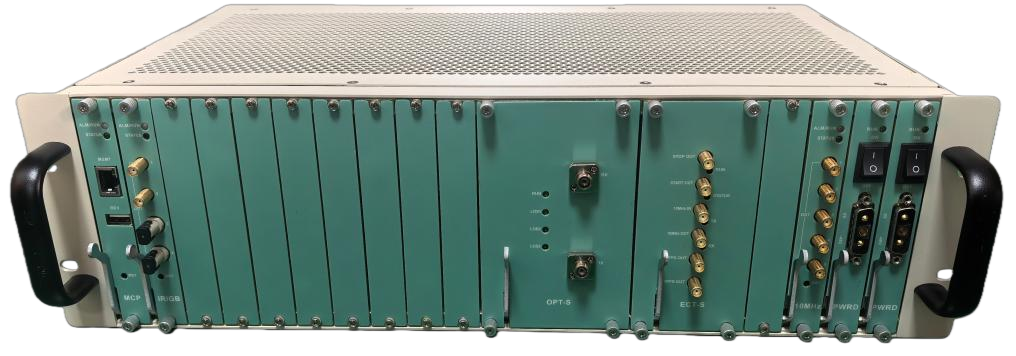
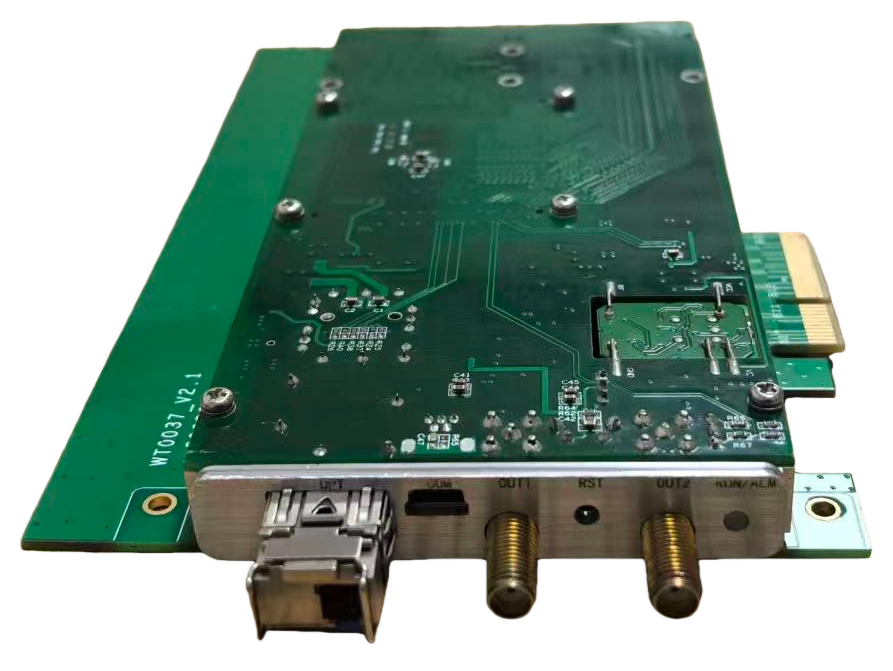
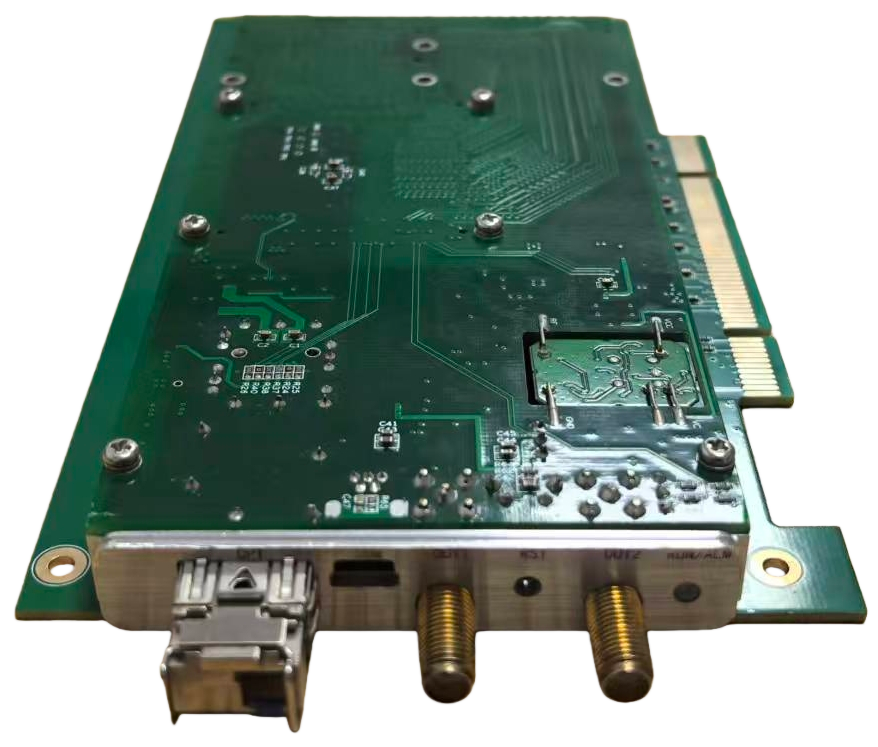
Timing is the first requirement of human information interaction since ancient times.Nowadays,information technology and communication technology are constantly updated with each passing day,and the requirements for time-frequency synchronization of various systems are getting higher and higher. For example, today’s 5G communication network requires the time source, time transmission, and end device, time synchronization performance to reach 10 to 30ns. In order to cope with the deployment of future networks, our company has specially developed the TFT3101 series of high-precision synchronous products.
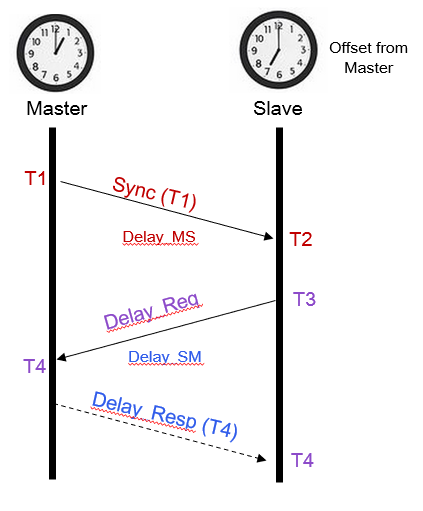
Since the release of the IEEE1588v2 (PTP) timing technology standard in 2008, PTP timing technology has been widely used around the world due to its convenience and high accuracy (relative to NTP), and now PTP timing technology is used as a high-precision long-distance time synchronization method by various industries such as Telecom Operator, Power Grid, and railway and subway communication networks.PTP timing technology realizes timing through the two-way message exchange in the figure below.
T1–The timestamp when the sync message departs from the master;
T2–The timestamp when sync message arrives at the slave;
T3– The timestamp when the delay request message departs from the slave
T4–The timestamp when delay response message arrives at the master;
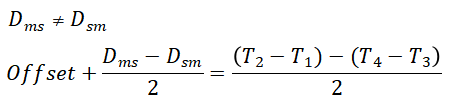
Dms- master to slave channel delay;
Dsm- slave to master channel delay;
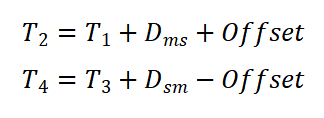
Offset- The time difference between slave and master device.
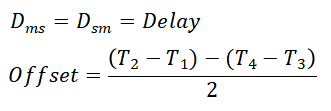
Symmetrical case:
Asymmetrical case:
From the above principle, it can be found that the current PTP timing technology can only calculate the time error by assuming that the go and back delay is equal, but this is not in line with the actual situation. The difference in the length of the round-trip optical cable of the transmission link and the difference in the uplink processing speed of the intermediate device will lead to unequal round-trip transmission delay (also known as asymmetric delay), and these errors will generally be added to the synchronization error of the slave device, that is, asymmetric delay Asym=(Dms-Dsm)/2.
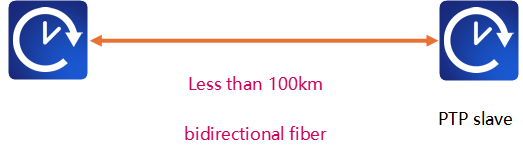
In order to eliminate the asymmetric delay of PTP as much as possible, engineers in the industry have used various methods to minimize the impact of asymmetric delay for many years. For example, use optical fiber transmission instead of electric cable transmission, try to use FPGA or other dedicated hardware circuits for timestamps as close to the physical layer as possible, and try to use bidirectional fiber transmission to avoid asymmetric delays caused by unequal distances between round-trip optical paths. But even so, the two channels going back and forth in the same optical fiber will cause asymmetric time delays due to the dispersion effect of light. Assuming that 1490nm is used as the outbound channel and 1550nm is used as the return channel. In a typical G.652 optical fiber, it is estimated that the asynchronous delay brought by 100km optical fiber is 50ns. For 5G time synchronization networks that pursue sub-nanosecond or even picosecond levels, this error is unacceptable.
In response to this key flaw that has restricted the development of PTP for many years, Taifu invented a method that can automatically measure the asymmetric delay of PTP in a single-fiber bidirectional environment and automatically compensate. The PTP synchronization mechanism implemented by this method can automatically eliminate the asymmetric delay caused by the fiber dispersion effect and improve the accuracy of PTP time synchronization.
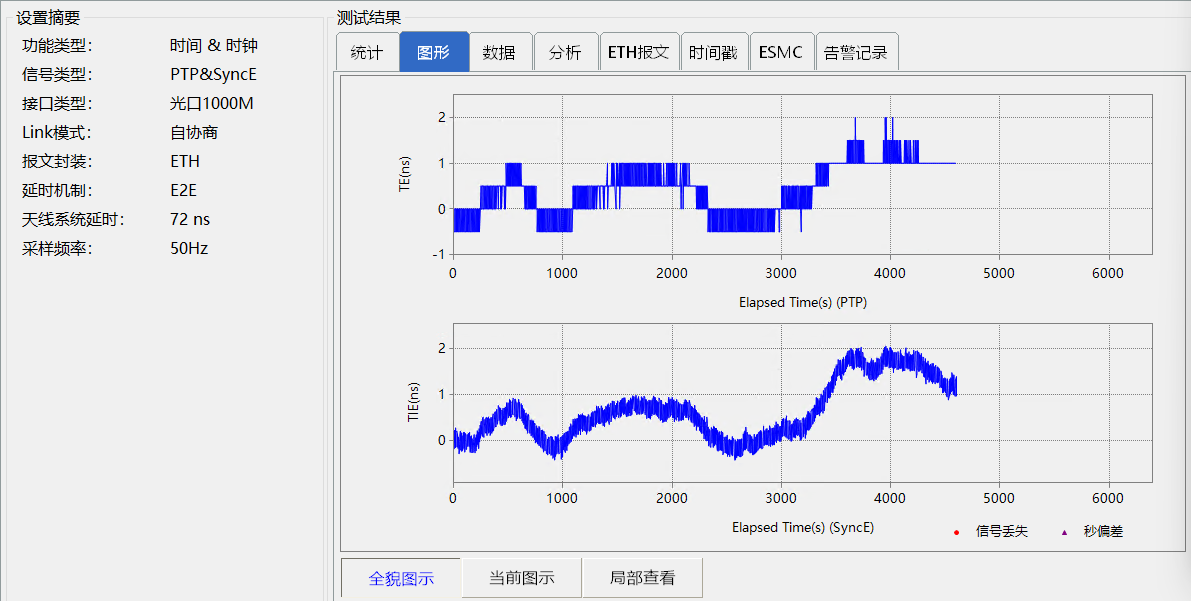
The PTP function of TFT3001 device integrates a patented technology on the basis of the G.8275.1 standard, which can accurately calculate and automatically compensate for the asynchronous delay caused by optical fiber dispersion, and truly achieve the master-slave clock synchronization deviation of ≤5ns, and the synchronization resolution ≤ 1ns.
Test Link
Test Result
If you have any questions, please feel free to consult via email or phone.
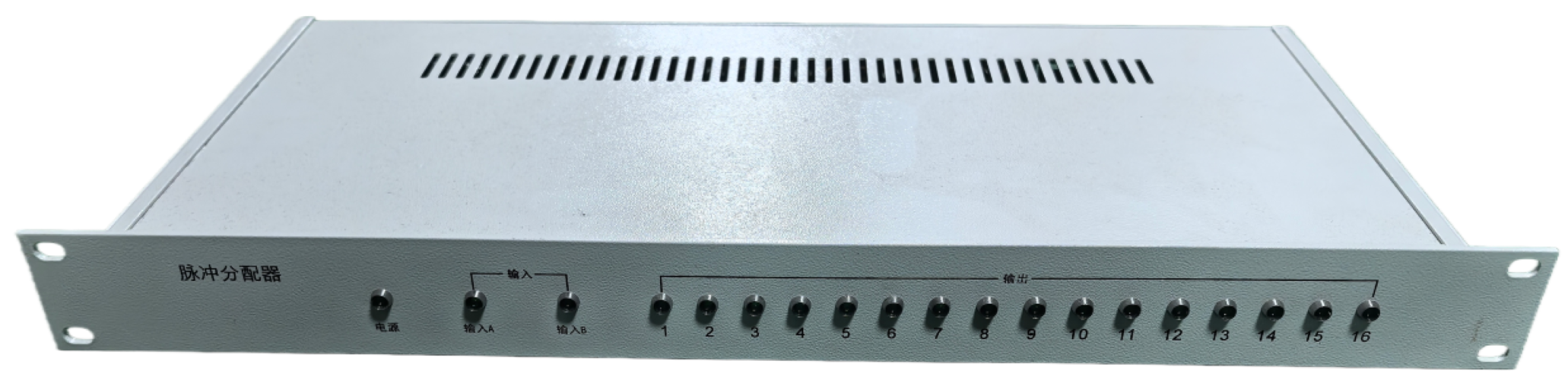
TFT1101 is a high performance pulse distribution device, it is driven by a 220V AC power supply. It included 2 switchable 1PPS inputs and 16 independent 1PPS outputs.
The TFT1005 timing card is installed in the data server to generate interrupt events or timestamps with a precision of less than 10ns for the data server. The TFT1005 must be used in conjunction with the TFT3001, where the TFT3001 time server provides time synchronization to the TFT1005 via the ground Beidou fiber timing protocol. The TFT1005 timing card provides precise time services to applications through a standard application programming interface (API), offering programmable interval time periodic interrupt-driven events and timed interrupt-driven events to meet the needs of users for secondary software development in specific application fields.
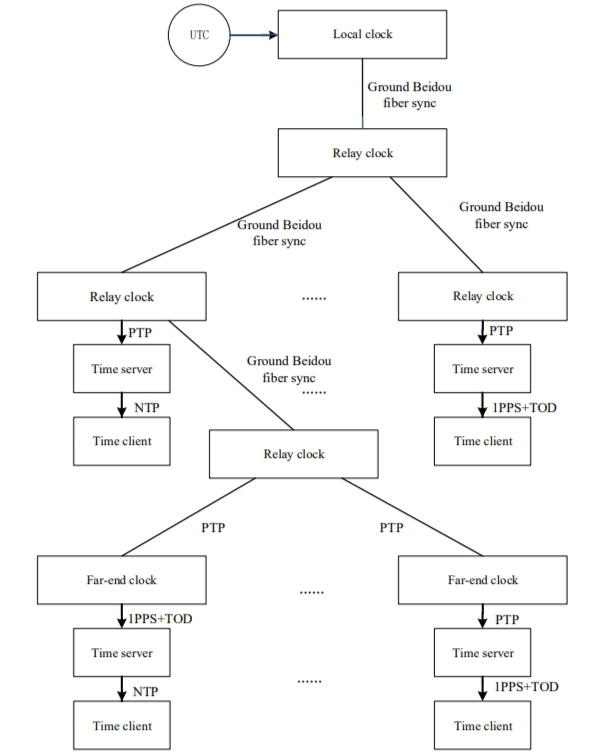
Commonly used network time synchronization technologies include NTP, PTP, 1PPS+TOD, and Taifu’s patented technology – Ground Beidou Time Synchronization, among others. Among them, NTP is mainly used for millisecond-level precision time synchronization in public networks or local area networks; PTP is mainly used for nanosecond-level precision time synchronization within dedicated networks; 1PPS+TOD is mainly used for nanosecond-level precision time synchronization over short distances (within 100 meters) in dedicated rooms; and Taifu’s patented technology – Ground Beidou Time Synchronization is mainly used for picosecond-level precision time synchronization over long distances in dedicated networks. A complete time synchronization network is typically a multi-node, long-distance time synchronization system composed of the above several time synchronization technologies, as shown in the following figure:
In such a complex time synchronization network, although end or intermediate nodes can obtain time information, there is no means to know where the obtained time information comes from or whether it is reliable. The traceable timing system invented by Taifu can well solve these problems.
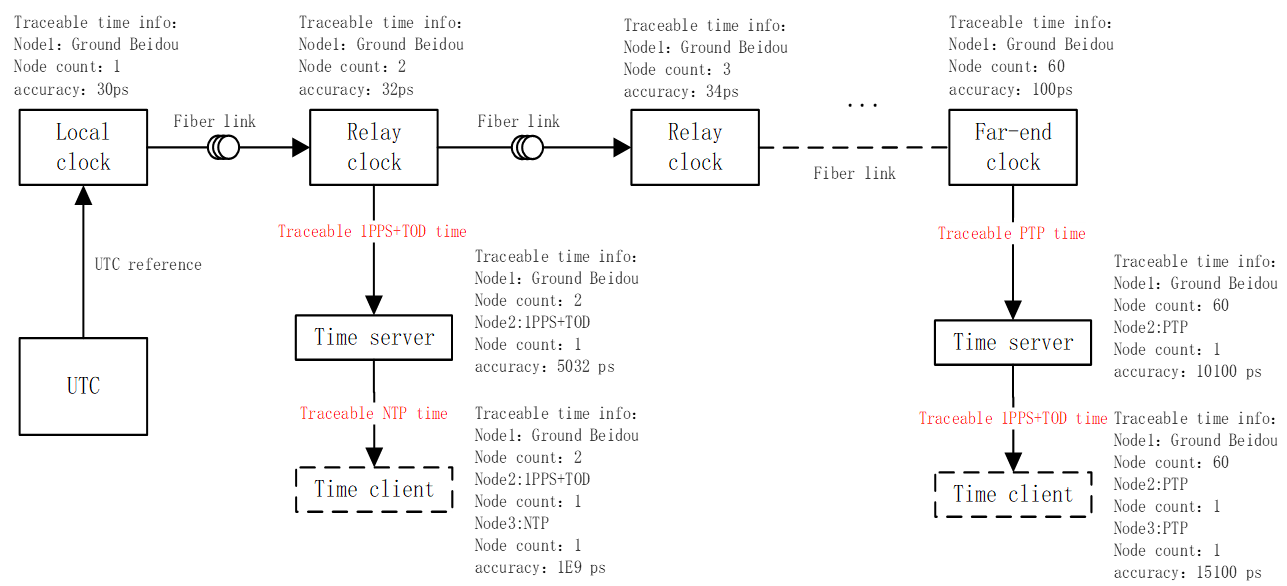
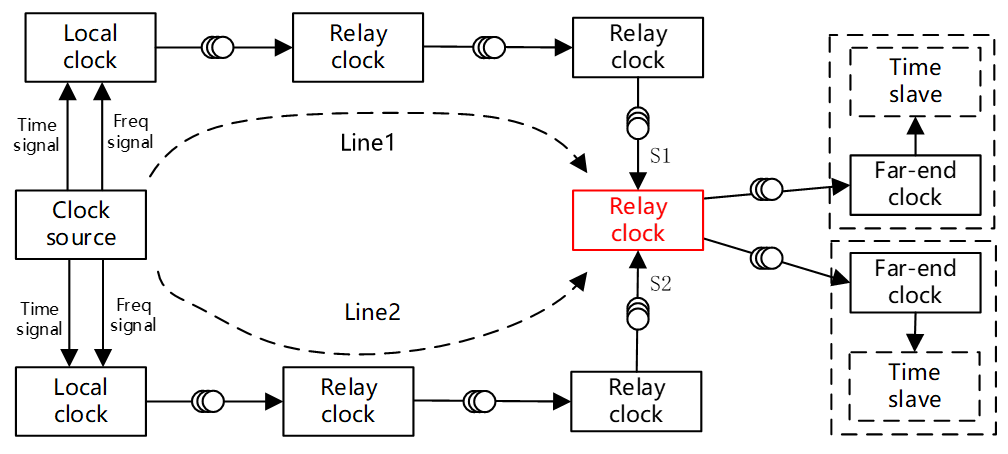
The traceable time system invented by Taifu extends reserved fields in NTP, PTP, or 1PPS+TOD information streams or uses other methods to fully pass time transmission path information downstream without affecting the original system’s time synchronization. This enables all nodes within the time synchronization network to be traceable. Any node can draw a traceable path diagram similar to the following figure based on real-time acquired traceable information in the device network management system.
In the figure, any node can obtain the ID, level, and accuracy information of the top clock source(Local clock) through tracing information, as well as the node type and node quantity has passed through before reaching the current node, and the estimated current time accuracy. Using this method, after passing through a multi-hop time transmission link, the time source information, the number of intermediate nodes passed through, and the estimated current accuracy remain visible, thereby increasing the credibility of the time information.
If you have any questions, please feel free to consult via email or phone.
What is Time & Frequency Network Intelligent Networking Technology?
Time synchronization has been the first need for human information interaction since ancient times. With the rapid development of information technology and communication technology today, various systems have increasingly stringent requirements for time and frequency synchronization. For example, 5G communication networks now require clock sources, clock transmission, and end-level clock synchronization performance to reach the sub-nanosecond level. High-reliability and high-precision time synchronization directly relates to the quality and transmission rate of 5G communication networks. According to clause 9.6.3.3 of 3GPP TS 38.104 V18.8.0 (2024-12), in 5G wireless communication technology, “in-band non-contiguous carrier aggregation” requires a synchronization accuracy of 260ns, “in-band contiguous carrier aggregation” requires a synchronization accuracy of 130ns, and for 480kHz and 960kHz high-frequency base stations, “in-band contiguous carrier aggregation” requires a synchronization accuracy of 32.5ns. Once the synchronization system fails, it will directly lead to the unavailability of related 5G services.
Since high-precision time synchronization networks are crucial for 5G services, major operators currently generally adopt a multi-source time scheme. Each device switches between various time sources based on manually preset priorities to maximize the availability of time sources. This approach does not take into account dynamic factors such as the average failure rate of each time source, which may lead to overly frequent switching of the time synchronization link, thereby affecting the stability of the time synchronization network. For example, a time-synchronized device has three time sources: S1, S2, and S3, with preset priorities of 1, 2, and 3 (1 being the highest priority, 2 next, and 3 the lowest). However, during a certain period, if S1 has an exceptionally high failure rate, the time-synchronized device will switch to S2 when S1 fails, and then switch back to S1 once S1 is restored, resulting in frequent switching phenomena that affect the stability of the time synchronization network.
Our company has designed a brand-new patented technology that adopts intelligent learning techniques. It real-time statistics the annual average downtime of each time source, and combines the time source’s accuracy and stability indicators. Through internal algorithms, it calculates the comprehensive priority of the time source, using this comprehensive priority as the selection standard. This ensures that the receiving timing devices always track the time source with the optimal comprehensive priority such as failure rate, accuracy, and stability, thereby improving the stability of the timing system. This solution can address the phenomenon where, when preset priority methods are used to switch time sources, high-priority time sources frequently experience failures and recover, leading to frequent switching between high and low priority time sources on the time server, thus enhancing the stability of the time server.
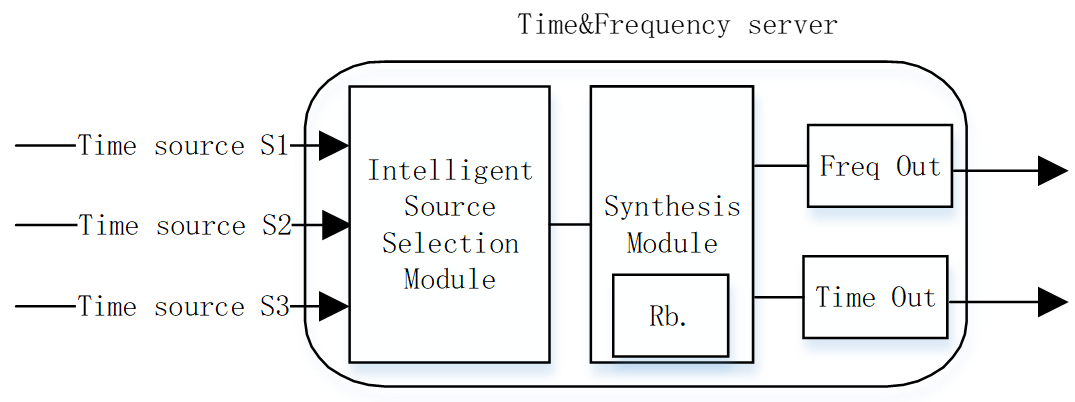
The principle block diagram of the time server with intelligent networking is as follows:
After S1, S2, and S3 time sources connected, they is an intelligent source selection module calculate the comprehensive priority, the time source with low failure rate, high accuracy, and high stability is finally selected for use by the synthesis module. This patent technology statistically utilizes the annual average available time, avoiding the frequent switching problems that may arise from the current preset priority-based source selection method, thereby improving system availability and stability. For fiber optic time synchronization systems requiring large-scale networking across the country, this technology can serve as a basic algorithm to form an nationwide intelligent timing network.
In addition, the time server has flexible networking capabilities. The aforementioned S1, S2, and S3 three (or more) time sources can be any type of input time source supported by the time server, such as ground PTP input time sources, 1PPS+TOD time sources, ground Beidou fiber time sources, GNSS satellite time sources, etc.
If you have any questions, please feel free to consult via email or phone.
The Ground Beidou fiber synchronization technology is mainly used to achieve high-precision time and frequency transmission over long-distance optical fiber links, providing high-precision time and frequency signals to each site along the entire optical fiber link. The application fields of Ground Beidou fiber synchronization technology include the following aspects:
National ground-based timing network – Optical fiber timing equipment transmits UTC time information through the optical fiber network to all parts of the country, forming a unified national ground-based optical fiber timing network. It can serve as a backup for the current satellite system. However, the time and frequency accuracy obtained through the ground is about a hundred times higher than that of satellite timing, and it is highly secure and reliable. At the same time, it can prevent electromagnetic interference.
Operator-specific networks – Currently, there are two methods for timing mobile base stations of operators. The first method uses GNSS satellite timing, which is limited by the vulnerability of wireless satellite signals. When wireless satellites are interfered with, deceived, or have equipment failures, it is impossible to achieve synchronization between base stations. The second method uses ground-based PTP or White Rabbit timing. Due to the fact that PTP or White Rabbit technology relies on manual measurement and compensation for asynchronous delays, it is not feasible in engineering implementation. Moreover, factors such as an increase in PTP device hops and temperature changes will also affect the accuracy of PTP timing. If Ground Beidou fiber synchronization technology is adopted, picosecond-level time reference output can be obtained at the end timing equipment, effectively ensuring the timing accuracy of each base station.
Power grid – With the development of the power grid, the smart grid has put forward higher requirements for time accuracy. Particularly in Traveling wave distance measurement devices, synchronous phasor measurement devices, merging units, lightning locating systems, power angle measurement systems, and power grid pre-decision analysis systems, the demand for time accuracy reaches the nanosecond level. Through the Ground Beidou fiber synchronization solution, the absolute time accuracy (compared with UTC) of each substation can be better than 500ps, thereby achieving absolute time synchronization between substations and meeting the requirements of time synchronization for global control and data analysis of the smart grid. At the same time, the time signal transmitted in the closed optical fiber is less susceptible to electromagnetic interference and deception signals, with high reliability and strong stability.
Military network – The military needs to build a timing and frequency synchronization network that is not easily interfered with and is stable and reliable. High-precision time and frequency synchronization plays a decisive role in areas such as command, control, communication and intelligence, navigation, technical reconnaissance, electronic warfare, missile guidance, and identification of friendly and enemy systems. It also has important applications in radar speed measurement and high-precision positioning. Ground Beidou fiber synchronization solution can help the military reduce its excessive reliance on GNSS satellite timing and achieve a space-ground mutual backup PNT system of GNSS satellite + ground-based timing.
The following is a comparison of the advantages and disadvantages of several mainstream fiber synchronization technologies currently available:
Feature
PTP
White Rabbit
Ground Beidou fiber synchronization
Accuracy
sub-microsecond to nanosecond
Sub-nanosecond
Less than 500ps
Error cumulative effect
Each PTP device introduces an error of 30ns to 500ns
Each hop white rabbit device introduces an error of 1ns to 5ns
Each fiber optic timing device introduces an error of 1ps to 2ps
Asynchronous delay
The asynchronous delay problem caused by the asymmetry of the round-trip path cannot be resolved
The asynchronous delay problem caused by the asymmetry of the round-trip link cannot be solved by algorithms. Instead, manual calibration is adopted, which has poor engineering practicality.
The asynchronous delay problem caused by the asymmetry of the round-trip link is solved by an algorithm, without the need for manual calibration.
Cost
Low (dedicated network card, switch)
High (dedicated hardware, fiber link)
High (dedicated hardware, fiber link)
Applications
Telecommunications, finance, industrial automation, radio and television
Telecommunications, particle physics, radio astronomy, synchronized phasor measurement
Telecommunications, particle physics, radio astronomy, synchronized phasor measurement
If you have any questions, please feel free to consult via email or phone.
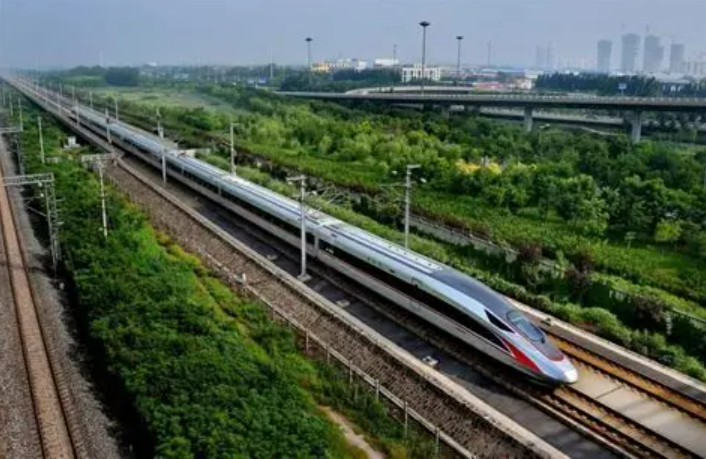
Recently, Sichuan Taifu has received good news: The company, relying on its profound technical accumulation and outstanding project implementation capabilities in the fields of time synchronization and Beidou application, has successfully won the bid for the China Railway Hohhot Clock Synchronization Network Equipment Single Beidou Transformation Project, the Clock Synchronization Equipment Transformation Project of Chengdu Bureau Group Co., Ltd., and the Time Clock Equipment Project of the Newly Built Guangzhou-Zhanjiang Railway. These successful bids not only mark a major breakthrough for Sichuan Taifu in promoting the “indigenization, autonomy, and controllability” of the country’s key infrastructure time synchronization systems, but also fully demonstrate the company’s comprehensive strength and leading advantages in high-precision positioning and time-frequency technology. Time synchronization is the “nerve center” for the stable operation of critical infrastructure such as power, communication, and finance. With the full completion and commissioning of China’s Beidou-3 global satellite navigation system, adopting the “single Beidou” mode for high-precision timing has become a strategic choice to enhance national information security and achieve independent control of the timing system, which is of great significance for reducing reliance on foreign satellite navigation systems. With the full completion and official launch of the Beidou-3 global satellite navigation system, China’s satellite navigation and location service industry has fully entered a new development stage dominated by Beidou. The so-called “single Beidou transformation” refers to the complete switch of the original equipment that relied on foreign navigation systems such as GPS to solely rely on China’s Beidou system for positioning, navigation and timing functions. This move not only significantly enhances the security level of the country’s key infrastructure and strengthens the system’s autonomy and controllability, but also helps to fully leverage the unique advantages of the Beidou system in high-precision timing and short message communication, providing more reliable and diverse service support for various industry applications. The above-mentioned winning projects aim to provide a set of safe, reliable and efficient domestic positioning solutions for China’s railway transportation sector. They are of great significance for ensuring the safety of urban transportation operations, enhancing the management level of the industry, and promoting the development of the Beidou industrial ecosystem. The clock synchronization network is the “nerve center” and “time heart” of the railway communication system, providing a unified, precise and reliable time reference for all core business systems such as train control, dispatching command and passenger services. The above-mentioned renovation projects aim to comprehensively upgrade the existing clock synchronization equipment that relies on foreign GPS systems to equipment that uses China’s independently developed Beidou Satellite Navigation System (BDS) as the sole time source. Upon the completion of the project, two core values will be achieved:
Safety, autonomy and controllability: Completely break away from the technical reliance on foreign satellite navigation systems, effectively avoid potential risks such as signal interruption, accuracy reduction, and malicious interference, greatly enhance the safety and reliability of key railway infrastructure in China, and build a “time barrier” for the safety of national railway transportation.
High Precision and High Reliability: The Beidou-3 global system features internationally leading timing accuracy and stability. A single Beidou clock synchronization device will provide nanosecond-level high-precision time synchronization signals for various railway systems, ensuring the efficient, coordinated and stable operation of core services such as train operation diagrams, signal interlocking, and CTC (Centralized Traffic Control), laying a solid foundation for the future construction of intelligent railways. The above-mentioned winning of the bid not only represents the high recognition of Sichuan Taifu’s technical strength and service level by the client, but also marks another milestone for the company in the field of “single Beidou” transformation in key industries. In the winning project, Sichuan Taifu will continue to provide high-quality services to China State Railway Group and various railway bureaus, ensuring the reliable operation of the equipment. In the future, it will continue to track the “single Beidou” transformation projects of the synchronous network of various railway bureaus, providing more railway bureaus with high-quality services of Sichuan Taifu’s Beidou equipment. It will continue to adhere to the development concept of “independent innovation and security controllability”, and continuously deepen the research and application of time synchronization and Beidou technology, contributing to the digital transformation and security guarantee of more industries.
Timing is the first requirement of human information interaction since ancient times. Nowadays, information technology and communication technology are constantly updated with each passing day, and the requirements for time-frequency synchronization of various systems are getting higher and higher. For example, today’s 5G communication network requires the time source, time transmission, and end device, time synchronization performance to reach 10 to 30ns. In order to cope with the deployment of future networks, our company has specially developed the TFT3001 series of high-precision synchronous products.
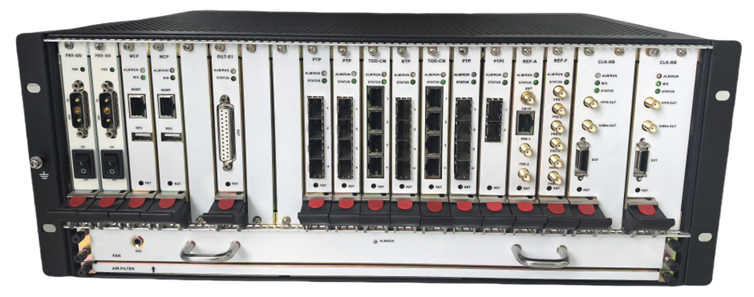
TFT3001 series high-precision synchronization equipment can be widely used in communication, power, military and other systems, with time frequency tracing, local clock tame, time transmission and time frequency output functions. TFT3001 Supports configuration and maintenance-free functions, and provides a network management platform and indicator display. The timing network can be a star, chain and complex models. The equipment output performance meet 30ns accuracy, it can be widely used in telecommunications, electric power and military communication, provide a reliable and high-performance time-frequency synchronization signals.
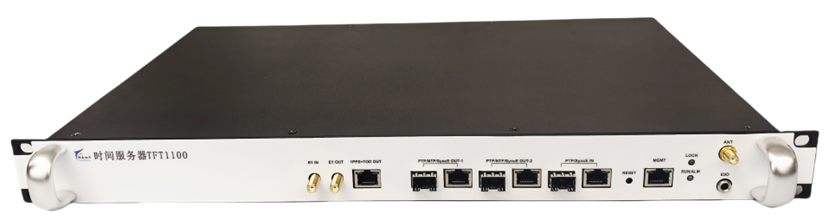
Timing is the first requirement of human information interaction since ancient times. Nowadays, information technology and communication technology are constantly updated with each passing day, and the requirements for time-frequency synchronization of various systems are getting higher and higher. For example, today’s 5G communication network requires the time source, time transmission, and end device, time synchronization performance to reach 10 to 30ns. In order to cope with the deployment of future networks, our company has specially developed low cost sync master TFT1100, it can be widely distributed in access networks.
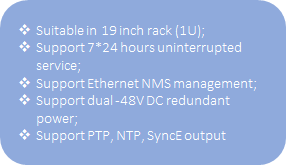
TFT1100 high-precision synchronization equipment can be widely used in communication, power, military and other systems, with time frequency tracing, local clock tame, time transmission and time frequency output functions. TFT1100 Supports configuration and maintenance-free functions, and provides a network management platform and indicator display. The timing network can be a star, chain and complex models. The equipment output performance meet 30ns accuracy, it can be widely used in telecommunications, electric power and military communication, provide a reliable and high-performance time-frequency synchronization signals.